Why the handlebar matters
On a walk around tape edge table the operator steers and controls the machine from a handlebar on the sew head. Everything they do while the machine is running goes through it: start, stop, speed, and on many machines the head tilt and the corner control as well. It is the interface, and it is also the part that gets the most wear, because it is held all day and it takes every knock the mattress gives it.
That makes it worth a look before you buy. A cracked casting, a sticky switch or a stretched cable is cheap to put right on a bench and expensive to discover after the machine is on your floor.
It is also the part of a used machine that tells you the most about how it was worked. A handlebar with clean, positive switches and an original cable has been run by people who were shown how to use it. One that has been taped, tied or drilled has been kept going, which is not the same thing, and it usually means the rest of the machine has been kept going too.
The handlebar is the one part of the machine an operator touches for eight hours. It is worth looking at before you buy.
The handlebar and the corner
The corner is where a tape edge machine is won or lost, and on a walk around table the corner is worked from the handlebar. The operator is walking backwards, holding the control, feeding a binding tape, and turning the head through about ninety degrees. Everything they need in that moment has to be under a thumb.
So when you look at a handlebar, look at what it can do without the operator letting go. If the machine has slow corner control, can they set it and use it from where they stand? If the head tilts, can they change the angle mid seam? A control that is technically fitted but out of reach at the corner is a control that will not be used, and the seam will show it.
The two styles, photographed
These are the two handlebars you will meet on tape edge sew heads. Both photographs are of real machines. They were the only public comparison of the two anywhere, and they are the reason this page exists.
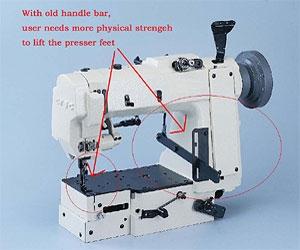
The old style
The older arrangement is still in service on a great many machines and there is nothing wrong with it. If the machine you are looking at has one, check the same things you would check on any control: that the castings are not cracked, that every switch acts cleanly, and that the cable has not been repaired with tape where it enters the head.
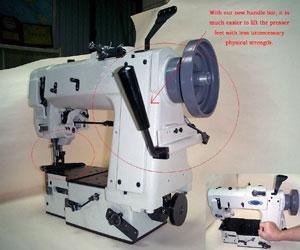
What to check on either style
The checks are the same whichever style is fitted, and an operator will tell you in a minute what a photograph will not.
- Every switch acts positively and returns. A switch that has to be held at an angle has been worn out.
- The casting is not cracked around the mounting or the grip.
- The cable is original into the head, with no taped repairs at the entry.
- The head starts, stops and changes speed from the handlebar alone, with nobody reaching for a panel.
- If the machine has motorized head tilt or slow corner control, both work from where the operator stands.
If you are not sure what you have
Send us a photograph. We look at these every week and we will tell you which style is on your machine and what condition the control is in, whether or not you are buying anything from us. If you are having a machine rebuilt, the handlebar and its cable are part of what we go through.
If you are after a replacement rather than an opinion, we need three things: a photograph of the handlebar itself, a photograph of the plate on the sew head, and a photograph of where the cable enters the head. The class of the head and the way the control is mounted are what decide whether a given part will fit, and neither can be read off a description.
And if the answer turns out to be that the control is fine and the machine around it is not, we will tell you that too. There is no sense in fitting a good handlebar to a carriage that wanders.