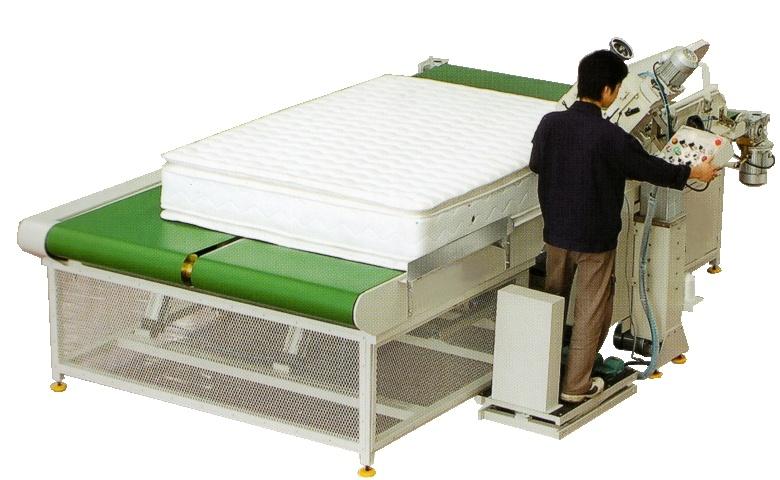
The reversal
On a walk around table the mattress is still and the sew head travels. On a conveyorized machine that is turned around: the head is fixed and a belt carries the mattress past it. The operator no longer walks the perimeter, which is the whole point, because walking the perimeter of a king mattress several hundred times a shift is the part of the job that wears people out.
The belt is usually an anti static PVC band. The head raises, lowers and tilts under power, and the machine slows itself at the corner and recovers afterwards in the same way a good table does, but under PLC control rather than by hand.
On a table the head walks the mattress. On a conveyorized machine the mattress walks the head. Everything else follows from that one reversal.
Turning and flipping
A perimeter has four sides, so something has to turn the mattress through ninety degrees three times. On these machines that is automatic: an arm swings the mattress square to the head and the belt takes it back into the seam. Once the first face is closed, a flip over unit turns the mattress over so the second face can be sewn without anybody lifting it.
That flip is the reason people buy these machines. A finished king mattress is heavy and awkward, and two people turning one by hand several hundred times a day is the real cost that a conveyorized line removes.
The numbers to ask for
The specifications below are the ones that appear on the conveyorized and flip over machines we have sold. They vary by model, and the only figures we will publish for a particular machine are the ones on its own record, but this is the list to work through.
- Mattress height range the machine will accept, usually quoted in millimetres.
- Conveyor speed, and whether straight and corner speeds are set separately.
- Head lift range and tilt range.
- Units per hour, and whether that figure assumes one face or both.
- Air supply, typically 6 bar, and the total electrical load.
- Supply voltage, phase and frequency.
- Overall footprint and belt height, because these machines need real floor.
- Control: PLC, inverter and touch panel, and whether remote support is available.
Is a conveyorized machine right for your line
Ask three questions. How many mattresses do you close a day, and is the tape edge station the thing holding the line up. How heavy are they, and how many people does it take to turn one. And how much clear floor do you have, because a conveyorized machine with a flip over unit is several times the footprint of a table.
If the answers are a high count, heavy mattresses and enough floor, the machine pays for itself in handling alone. If you close a moderate number of mixed sizes on a tight floor, a well rebuilt table with slow corner control and a powered lift will serve you better and cost you less to keep running.
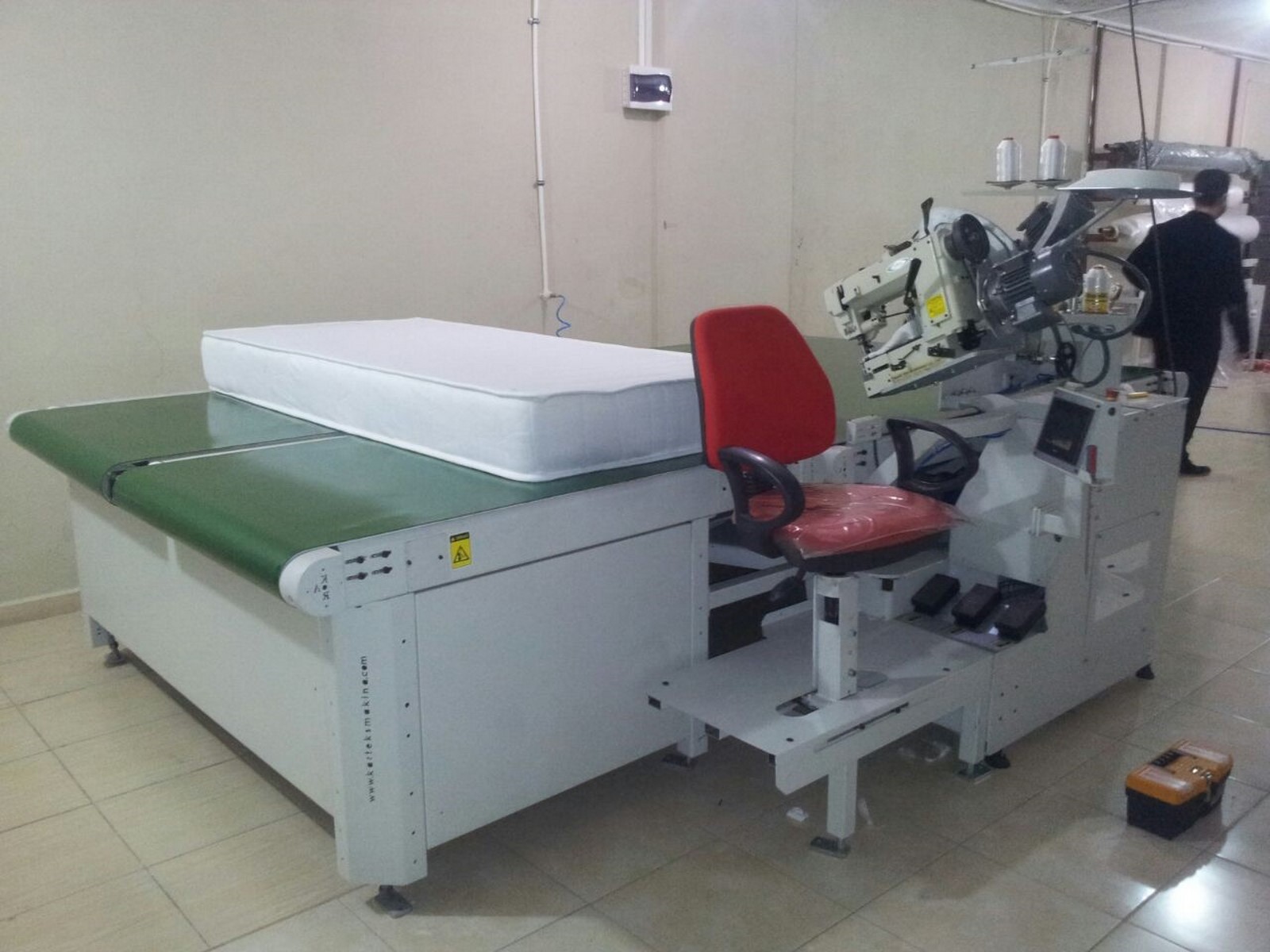
Buying one used
Two things carry the risk on a used conveyorized machine, and neither is the sewing head. The first is the control system: a PLC and a touch panel that are no longer supported are a problem you inherit. Ask what is fitted and whether the program is available. The second is the flip over unit, which is the most heavily worked mechanism on the machine.
We inspect both, we run the machine under power before it is crated, and we will send you a video walk around so you can watch it turn and flip a mattress before you commit.