What the machine is for
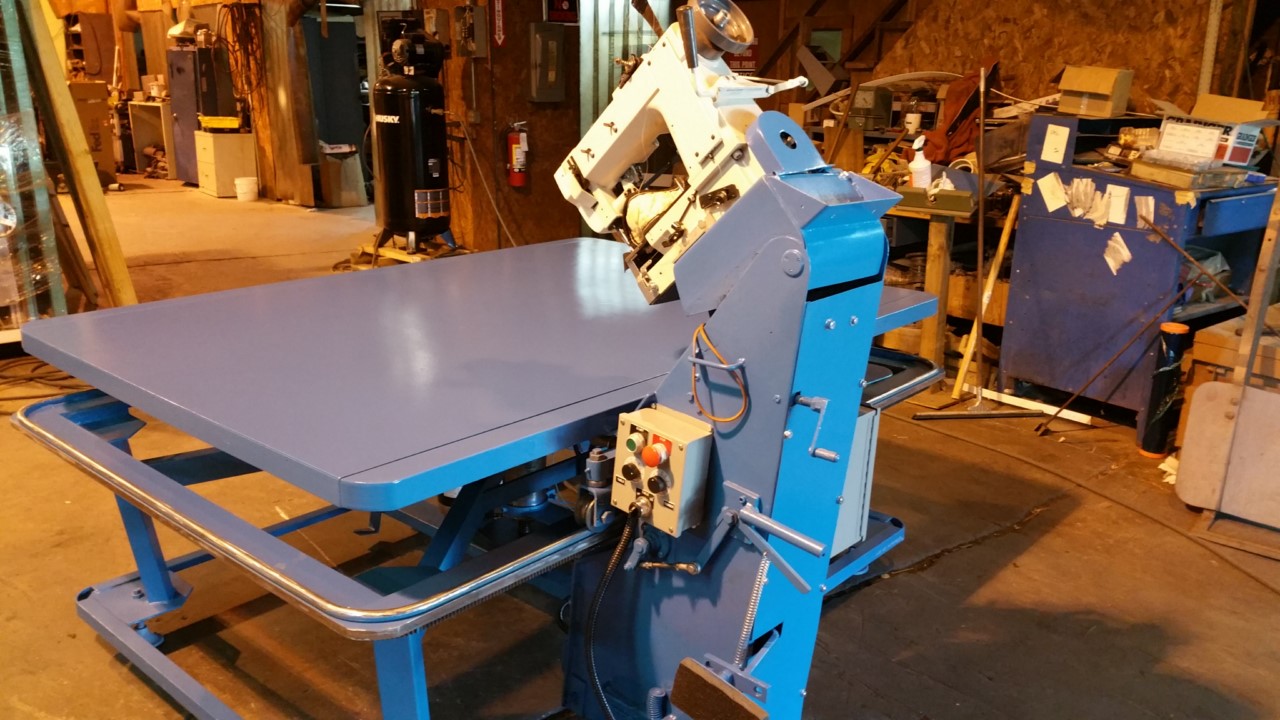
A tape edge machine closes a mattress. The top panel, the border and the bottom panel arrive at the machine as three separate pieces, and the machine sews a binding tape over the whole perimeter so they leave as one mattress. It is the last sewing operation on the line and it is the one a customer sees, so the seam has to be straight, evenly tensioned and square at the corners.
Almost every machine you will meet does that job in one of three layouts. On a walk around table the mattress sits still and the operator walks it past a moving sew head. On a sit down or non walk around machine the operator stays in one place and the mattress is turned to them. On a conveyorized machine a belt carries the mattress and the head stays fixed, and a flip over unit turns the mattress for its second face.
A tape edge machine is a sewing head that walks a mattress. Everything else on it exists to hold the mattress still and to move the head at the right speed.
The table
The table is the flat surface the mattress lies on, and it is what sets the largest mattress the machine can close. Full, queen and king are the three sizes that matter, and a queen table with extensions will take a king. The top is either painted steel or stainless steel. Stainless is worth asking for: it does not mark the ticking, and it is what most of the rebuilt tables we ship carry.
The table also lifts. A tape edge is sewn at a comfortable height for the operator, so the table rises and falls under power, and the range it covers is what people mean by mattress height capacity. Twelve inches is the low end you will find on older iron. Eighteen, twenty and twenty two inches are common. Twenty four inches is the top of what the machines we rebuild will do.
- Table size: full, queen, king, or a queen with extensions to king.
- Top: painted steel or stainless steel.
- Lift: powered, and its range is the mattress height the machine can close.
The carriage
The carriage is the arm that carries the sew head around the mattress. It runs on a track, it is driven through a clutch or an electronic drive, and it is the part of the machine that decides whether the seam is straight. A worn carriage wanders, and a wandering carriage is the most common reason a machine gets sent to us.
Older machines drive the carriage through a mechanical clutch. Later machines use an electronic drive with a potentiometer or a PLC behind it, which is what makes a separate straight speed and corner speed possible. Both are rebuildable. What is not negotiable is the track and the bearings: those get replaced, not adjusted.
The sew head
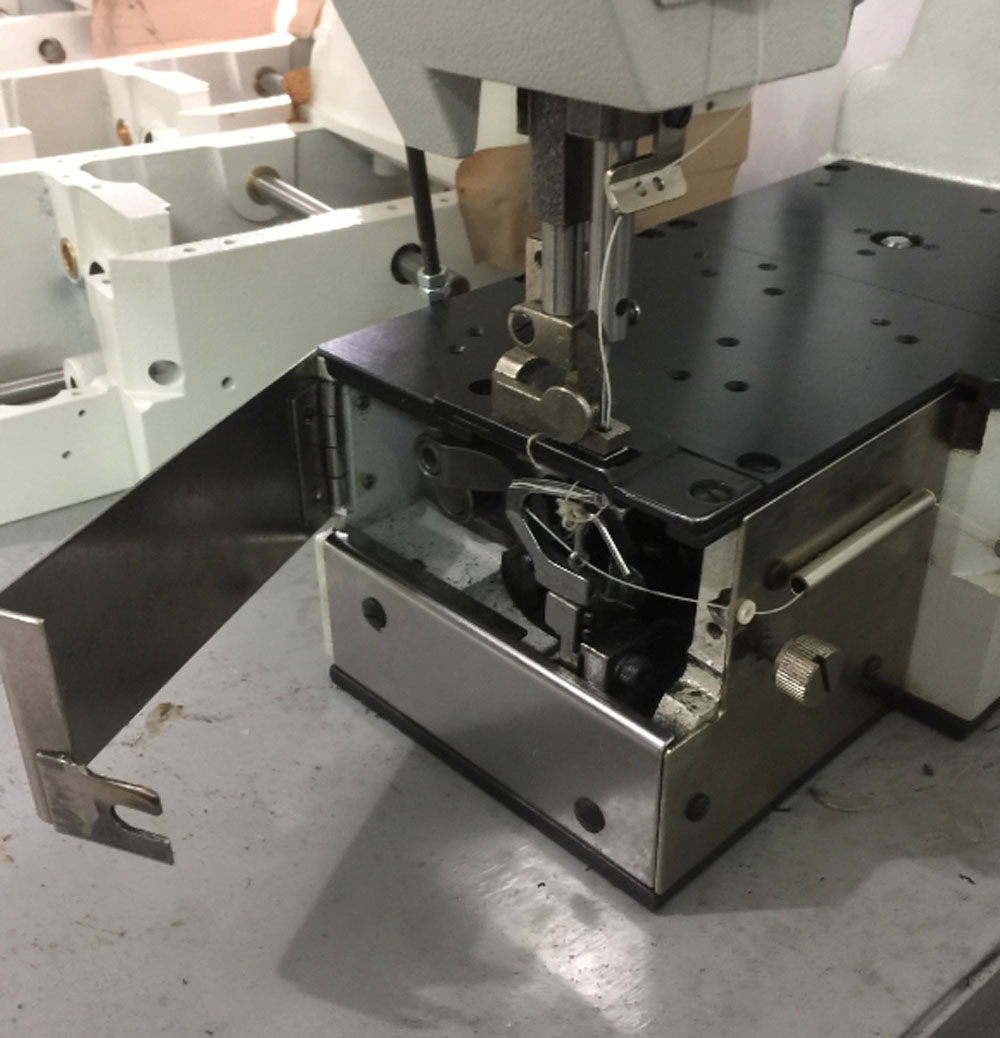
The head is a heavy duty chainstitch sewing machine mounted on the carriage. On American tape edge tables it is almost always a Singer 300U or a Singer 300W, and on European built machines it is often a Pfaff. The stitch is a single needle two thread chainstitch, used here rather than a lockstitch because it can be run fast and because it will not pucker a thick binding.
The numbers people ask for are always the same four. Maximum sewing speed on a 300U is 3000 rpm. The needle system is 62x59. Maximum sewing thickness is 11 to 12 mm. The feed is a compound feed, which is what lets it pull a heavy quilted panel and a tape through together without one slipping against the other.
The head also tilts. On a good machine the tilt is motorized, so the operator can change the angle the needle enters the border without stopping. That is worth having, and it is one of the options we fit during a rebuild.
The corner is the whole problem
Sewing a straight run is easy. The corner is where a tape edge machine is won or lost, because the head has to turn about ninety degrees while the tape keeps feeding evenly, and it has to do it without stopping the seam. If the head arrives at the corner at full straight line speed the tape gathers on the inside of the turn and the corner comes out lumpy.
The answer is slow corner control. A sensor or a cam tells the drive that a corner is coming, the carriage slows to a separately set corner speed, the turn is made, and the machine recovers to straight line speed on the other side. On the machines we rebuild it is either an original mechanical arrangement we go through and reset, or an electronic control we fit with the new drive. Ask about it on any machine you look at. It is the difference between a machine an operator can run all day and one they fight.
Over electric and under electric
You will see both phrases on American tape edge iron. Over electric means the power and control cabling reaches the head from above, on a boom or a festoon. Under electric, also written undercurrent, means it is fed from beneath the table. Under electric keeps the cable off the operator and out of the way of the mattress, and it is what most buyers ask for.
Supply is usually 220 V or 380 V, single or three phase, at 50 or 60 Hz. This matters more than people expect on a used machine, because a table built for one supply has to be rewired for another, and rewiring is a rebuild job rather than an adjustment. Tell us your supply when you enquire and we will tell you what a given machine needs.
What wears out first
In the order we find it: the carriage track and bearings, the clutch, the head bushings and hook, the table lift motor, then the electrics. Paint and sheet metal look like the problem and almost never are. A machine that has been fed and oiled and has a straight track is worth rebuilding. A machine with a bent frame is not.
That order is also the order of our own rebuild, which is why the process reads the way it does: strip to the frame, machine and replace the wear parts, rebuild the head, paint, then run and test under power.