The short answer
Both are Singer heavy duty chainstitch heads built for closing mattresses, both have been fitted to American tape edge tables for decades, and both are still rebuildable today. If a machine you are looking at carries either one, the head is not the reason to walk away.
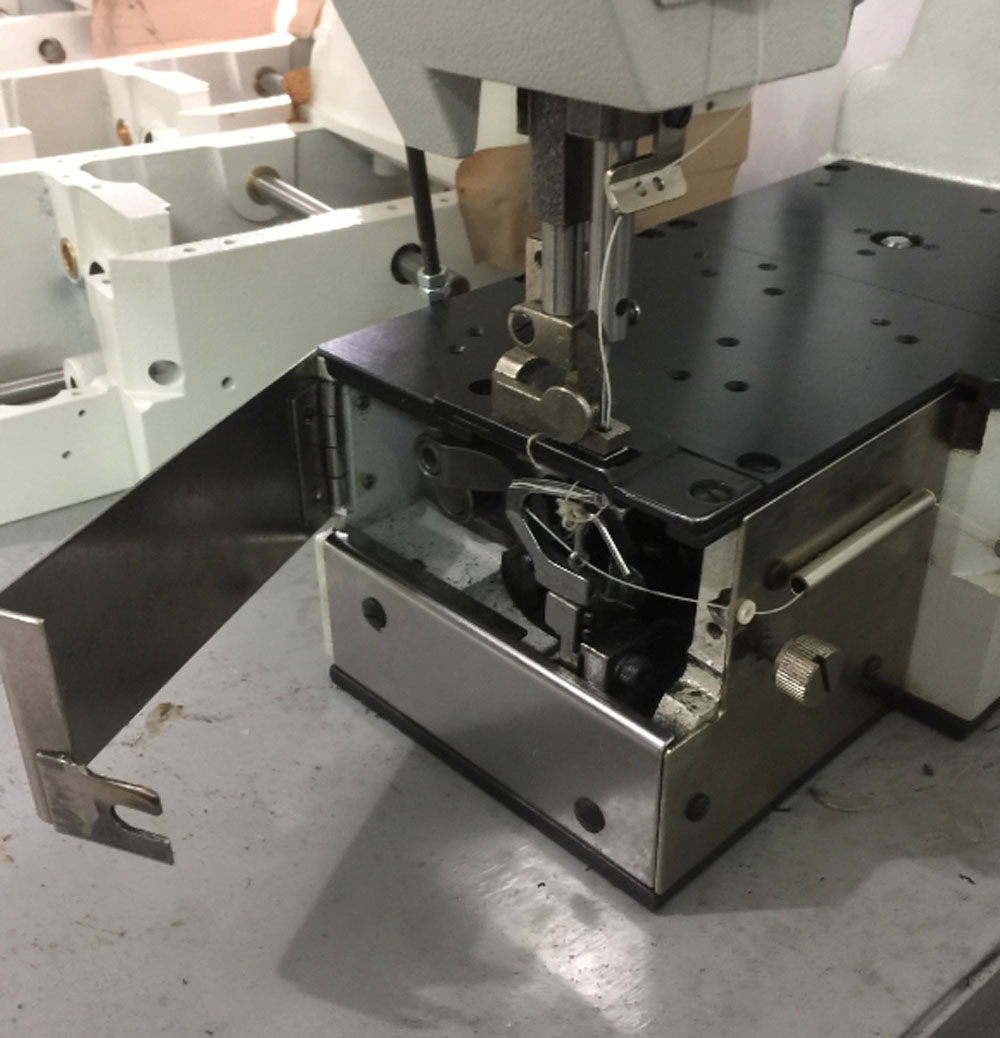
The 300U is the one you will meet most often, and it is the head we fit to most of the tables we rebuild. The 300W turns up on older machines and on tables built for a particular customer. We rebuild and sell both, and we photograph both, so you can compare a real head rather than a catalogue drawing.
Both heads sew a good mattress. The question is which one your mechanic already knows and which one you can get needles for on a Friday afternoon.
The 300U, by the numbers
These are the figures we publish on every 300U head we sell, and they are the ones a buyer actually needs when they are working out whether a head will suit their line.
- Stitch: single needle, two thread chainstitch.
- Maximum sewing speed: 3000 rpm.
- Needle system: 62x59.
- Maximum sewing thickness: 11 to 12 mm.
- Feed: compound feed.
- Machine pulley 74 mm, bed shaft drive pulley 64 mm.
- A new head packs at about 45 kg in a 740 by 380 by 570 mm case.
Why a chainstitch and not a lockstitch
A tape edge seam is long, thick and fast. A lockstitch head carries its second thread on a bobbin, and a bobbin runs out, which on a perimeter seam means a stop and a join in the middle of a mattress. A chainstitch head takes both threads from cones, so it runs until the cone is empty.
The chainstitch also gives on a thick corner instead of pulling the panel in, which is what you want when the head is turning through a corner with a binding tape, a border and two quilted panels under the foot at once. The trade is that a chainstitch can be pulled out if it is not locked off properly at the end of the run, which is an operator habit rather than a machine fault.
Telling them apart in a photograph
The class is cast or stamped on the head itself, and on a used machine that plate is the only answer we will give you. We photograph it. If the plate is missing or unreadable we say so on the listing and we do not guess, because a head sold as the wrong class is a head whose parts do not fit.
Two things people ask that are not a way to tell them apart: the colour of the paint, and the shape of the handlebar. The paint is whatever the last rebuilder used. The handlebar is a separate change that is worth an article of its own, and it is found on both classes.
Parts, needles and who will service it
Ask two questions before you choose a head. First, can you get needles quickly. The 300U runs needle system 62x59 and that is a system your existing supplier will almost certainly stock. Second, who is going to time and adjust it. A tape edge head is not a domestic sewing machine, and a mechanic who has never had the cover off one will be slow the first time.
If the answer to either question is uncomfortable, that is an argument for buying a head we have already rebuilt rather than one you are about to inherit. We time, test and run every head we sell, and we can send photographs and a video walk around of the actual head before it is crated.
What a rebuilt head means here
A head we call rebuilt has been stripped, its wear parts replaced, its hook and feed reset, its motor and controls checked, and it has been run under power before it goes in the crate. It is not a cleaned and painted head. Where we have only been able to service a head rather than rebuild it we say serviced, and we say what was and was not done.
You can buy a head on its own or on a table. If you are buying a head on its own, tell us the table it is going on, because the mounting and the drive pulley have to match.